NCERT Solutions for Class 7 Science Chapter 11 Light
Q.1.Fill in the blanks:
(a) An image that cannot be obtained on a screen is called ___________ .
(b) Image formed by a convex is __________ always virtual and smaller in size.
(c) An image formed by a __________ mirror is always of the same size as that of the object.
(d) An image which can be obtained on a screen is called a __________ image.
(e) An image formed by a concave __________ cannot be obtained on a screen.
Answer
(a) virtual image (b) mirror (c) plane (d) real (e) lens
Q.2.Mark ‘T’ if the statement is true and ‘F’ if it is false:
(a) We can obtain an enlarged and erect image by a convex mirror. (T/F)
(b) A concave lens always form a virtual image. (T/F)
(c) We can obtain a real, enlarged and inverted image by a concave mirror. (T/F)
(d) A real image cannot be obtained on a screen. (T/F)
(e) A concave mirror always form a real image. (T/F)
Answer
(a) F (b) T (c) T (d) F (e) F
Q.3. Match the items given in Column I with one or more items of Column II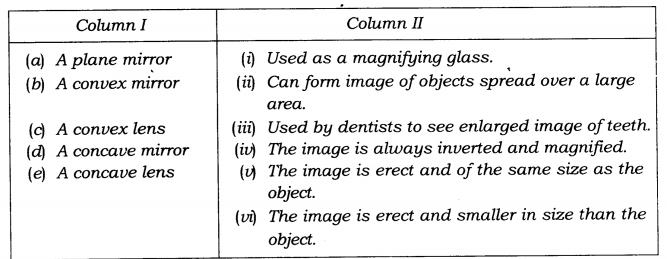
Answer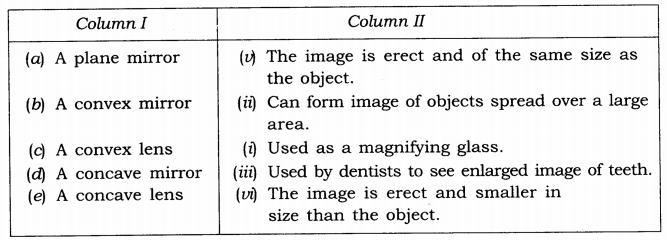
Q.4.State the characteristics of the image formed by a plane mirror.
Answer
(i) Image distance and object distance are equal.
(ii) The size of the object and image are equal.
(iii) The image formed is erect and virtual.
(iv) Images are laterally inverted.
Q.5.Find out the letters of English alphabet or any other language known to you in which the image formed in a plane mirror appears exactly like the letter itself. Discuss your findings.
Answer
Letters like A, H, I, M, O, T, U ,V, W etc. appear same when seen through a plane mirror
Q.6.What is a virtual image? Give one situation where a virtual image is formed.
Answer
The image which cannot be taken on a screen is called virtual image. When some object is placed very close to the concave mirror we don’t get any image on the white screen placed behind the mirror. Such image is called virtual image.
Q.7. State two differences between a convex and a concave lens.
Q.8. Give one use each of a concave and a convex mirror.
Answer
Use of concave mirror:
Concave mirror is used by dentists to examine the teeth.
Use of convex mirror:
Convex mirror is used as side view mirror in vehicles
Q.9. Which type of mirror can form a real image?
Answer
Concave mirror can form a real image.
Q.10. Which type of lens forms always a virtual image?
Answer
Concave lens always forms a virtual image.
Choose the correct option in Questions 11-13:
Q.11. A virtual image larger than the object can be produced by a
(i) concave lens (ii) concave mirror (iii) convex mirror (iv) plane mirror
Answer
(ii) concave mirror
Q.12. David is observing his image in a plane mirror. Die distance between the mirror and his image is 4 m. If he moves 1 m towards the mirror, then the distance between David and his image will be
(i) 3 m (ii) 5 m (iii) 6 m (iv) 8 m
Answer
(iii) 6 m
Q.13. The rear view mirror of a car is a plane mirror. A driver is reversing his car at a speed of 2 m/s. The driver sees in his rear mew mirror the image of a truck parked behind his car. The speed at which the image of the truck appears to approach the driver will be
(i) 1 m/s (ii) 2 m/s (iii) 4 m/s {iv) 8 m/s
Answer
(ii) 4 m/s
Comments
Post a Comment