NCERT Solution for Class 8 Geography Chapter 4 Agriculture कृषि
Question 1.
Answer the following questions.
(i) What is agriculture?
कृषि क्या है?
Answer
Agriculture is a primary activity. It includes growing
crops, fruits, vegetables, flowers and rearing of livestock. Two-thirds of India’s population is
still dependent on agriculture.
(ii) Name the factors influencing agriculture.
उन कारकों का नाम बताइए जो कृषि को प्रभावित कर रहे हैं।
Answer
The main factors influencing agriculture are
climate, soil quality and favourable topography.
कृषि को प्रभावित करने वाले मुख्य कारक जलवायु, मिट्टी की गुणवत्ता और अनुकूल स्थलाकृति हैं।
(iii) What is shifting cultivation? What are its disadvantages?
स्थानांतरी कृषि क्या है? इस कृषि की क्या हानियाँ हैं?
Answer
A plot of land is cleared by felling the trees and burning
them. The ashes are then mixed with the soil and crops
like maize, yam, potatoes and cassava are grown. After
the soil loses its fertility, the land is abandoned and the
cultivator moves to a new plot.
Disadvantages are:
(1) The land loses its fertility after use.
(2) Soil erosion.
कृषि की हानियाँ:|
(1) उपयोग के बाद भूमि अपनी उर्वरता खो देती है।
(2) मृदा अपरदन।
(iv) What is plantation agriculture?
रोपण कृषि क्या है?
Answer
Plantation agriculture is a type of commercial farming where only a single crop (like tea, coffee, sugarcane, cashew, rubber, banana or cotton) is grown.
वृक्षारोपण एक प्रकार की व्यावसायिक खेती है जहां चाय, कॉफी, गन्ना, काजू, रबर, केला या कपास की एकल फसल बड़ी मात्रा में श्रम और पूंजी का निवेश करके उगाई जाती है।
(v) Name the fibre crops and name the climatic conditions required for their growth.
सरकार किसानों को कृषि के विकास में किस प्रकार मदद करती है?
Answer:
Two major fiber crops are jute and cotton.
(1) Jute grows well on alluvial soil and requires high temperature, heavy rainfall, and a humid climate for its growth.
(2) Cotton needs high temperatures, light rainfall, and bright sunshine for its proper growth.
जूट और कपास को रेशेदार फसल के रूप में जाना जाता है। इनके विकास के लिए जलवायु परिस्थितियाँ इस प्रकार हैं:
1. जूट (गोल्डन फाइबर) उच्च तापमान (25⁰C से अधिक), भारी वर्षा, गर्म और आर्द्र।
2. कपास उच्च तापमान (30⁰C – 40⁰C), तेज धूप, कम वर्षा और साफ आसमान (बादल मुक्त धूप वाला दिन)।
Question 2.
Tick the correct Answer:
(i) Horticulture means
(a) growing of fruits and vegetables
(b) primitive farming
(c) growing of wheat
(क) गेहूँ उगाना (ख) आदिम कृषि (ग) फलों व सब्जियों को उगाना
Answer
(a) tea
(b) cotton
(c) jute
(क) चाय (ख) कपास (ग) पटसन
(iii) Leading producers of coffee
(a) Brazil
(b) India
(c) Russiac
(ii) कॉफी का प्रमुख उत्पादक है-
(क) ब्राजील (ख) भारत (ग) रूस
Answer
(a) Brazil
(क) ब्राज़ील
Question 3.
Give reasons.
(i) In India agriculture is a primary activity.
(ii) Different crops are grown in different regions.
कारण बताइए
(i) भारत में कृषि एक प्राथमिक क्रिया है।
(ii) विभिन्न फ़सलें विभिन्न प्रदेशों में उगाई जाती हैं।
Answer:
(i) Agriculture is an activity of growing crops, fruits, vegetables, flowers, and rearing of livestock. It is a primary activity since it directly involves natural resources. In India, a huge number of people derive the activity from their ancestors. Due to lack of literacy in general, farmers prefer agriculture since they acquire the required skills from their ancestors, and so feel comfortable with it.
(ii)
- Different topography
- Different soils
- Different climates
- Different lifestyles of the people in different regions.
(i) भारत की दो-तिहाई आबादी अभी भी कृषि पर निर्भर है। इसीलिए भारत में कृषि एक प्राथमिक गतिविधि है। एक बड़ी आबादी विस्थापित हो जाती है।
(ii) अलग-अलग क्षेत्रों में अलग-अलग फसलें उगाई जाती हैं क्योंकि अलग-अलग क्षेत्रों में मिट्टी की अनुकूल स्थलाकृति और जलवायु की स्थिति बहुत भिन्न होती है। इसके अलावा फसलों का प्रकार भौगोलिक परिस्थितियों, उपभोक्ताओं की मांग और प्रौद्योगिकी के स्तर पर भी निर्भर करता है।
Question 4.
Distinguish between the following.
(i) Primary activities and secondary activities.
(ii) Subsistence farming and intensive farming.
Answer:
(i)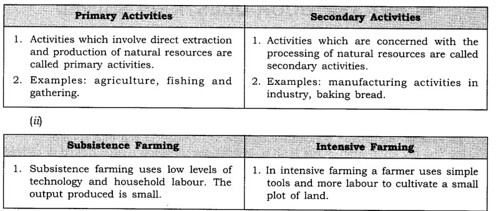
Question 5.
Find out the difference between the lifestyle of farmers in the USA and India on the basis of pictures collected from magazines, books, newspapers and the internet.
Answer:
The lifestyle of an Indian farmer is quite different from that of a farmer in the USA. An Indian farmer does not have much land whereas the average size of a farm in the USA is about 250 hectares. An Indian farmer lives in his house but an American farmer lives in his farm. A farmer in India applies his own experience, and advice of other farmers and elders regarding farming practices. But a farmer in the USA gets his soil tested in laboratories to assess the nutrients of the soil. An Indian farmer does not know of any technical advancements whereas a farmer in the USA has a computer which is linked to the satellite. In comparison to an Indian farmer, an American farmer is much more advanced in every aspect.
Comments
Post a Comment